0
SHOPPING CART
BASKET EMPTY
CHECK THE PRODUCTS
CHECK THE PRODUCTS

Region:Huila
Farm: El Progreso
Farmer: Rodrigo Sanchez
Variety:Caturaa, bourbon
Process: Washed Carbonic Maseration
Altitude: 1650masl
Harvest: 2023/24
Espresso/Brew





Notes Of A Roaster From The Underground: orange, vanilla, lemongrass, rum
 Omni-roast (Espresso/Brew)
The farm El Progreso is located in the village of El Carmelo, municipality of Palestina, at an altitude of 1650 m.a.s.l.
El Progreso is a family farm run by Rodrigo Sánchez Valencia, continuing the tradition started by his grandfather. And from this very plantation (with 5 ha at that time) Rodrigo began his business over 20 years ago. Now the territory of the farm is 23 hectares. On clay loam soils the family cultivates varieties such as Caturra and Colombia accompanied with small crops of Bourbon and Gesha.
In addition to El Progreso, Rodrigo has 2 more farms: Monteblanco and La Loma and to manage them the company Aromas del Sur was created. In 2017, he and his team built a cupping lab on La Loma to handle sample roasting, crop evaluation, and sourcing at origin.
In 2017 and 2018, Monteblanco coffee took first and second place, respectively, in the Yara Champion Program, and in 2019 it won Roasters United.
WASHED CARBONIC MACERATION
After the coffee reaches the processing area, it is rafted (floats) in order to eliminate by density those dry beans, brocades, leaves, voids that may affect the homogeneity of fermentation in addition to improving the physical quality of the coffee.
After selection, the coffee is deposited in plastic bins to ferment in cherry for a period of 70 hours, with CO2 injection. This helps to improve the sweetness of the coffee and the body of the final drink, in addition to intensifying the fruity notes in the cup. The changes in this first stage are more enzymatic.
Then the coffee is pulped and placed again in the bins with its own juice rich in sugars and microorganisms. These bins are hermetically covered to start the fermentation that, thanks to the microorganisms, begin to metabolize the sugar chains of the mucilage, developing better fragrance attributes and acidity. CO2 is injected that displaces the oxygen (O2) existing in the bin, leading to a maceration environment. This lasts between 70 to 94 hours and the total time of frermentation makes 140 and 188 hours.
Then coffee is washed and dried for a period of 18 to 22 days.
Beans are stored in the bags for one or two months. Before sending for export, they are cleaned using a huller machine.
Coffee came to Colombia in the late 1700s by way of Jesuit priests who were among the Spanish colonists, and the first plantings were in the north of the country, in the Santander and Boyaca departments. Throughout the 19th century, coffee plants spread through the country, with a smaller average farm size than more commonly found throughout other Latin American producing countries.
Commercial production and export of coffee started in the first decade of the 1800s, but remained somewhat limited until the 20th century: The 1927 establishment of the Federación Nacional de Cafeteros de Colombia (aka FNC, see below) was a tremendous boost to the national coffee industry, and Colombia quickly established itself as a major coffee-growing region, vying with Brazil and Vietnam for the title of top global producer.
Colombia still produces exclusively Arabica coffee, and though the country suffered setbacks and lower yields from an outbreak of coffee-leaf rust in the early 2010s, production has fairly bounced back thanks to the development and spread of disease-resistant plants, as well as aggressive treatment and preventative techniques.
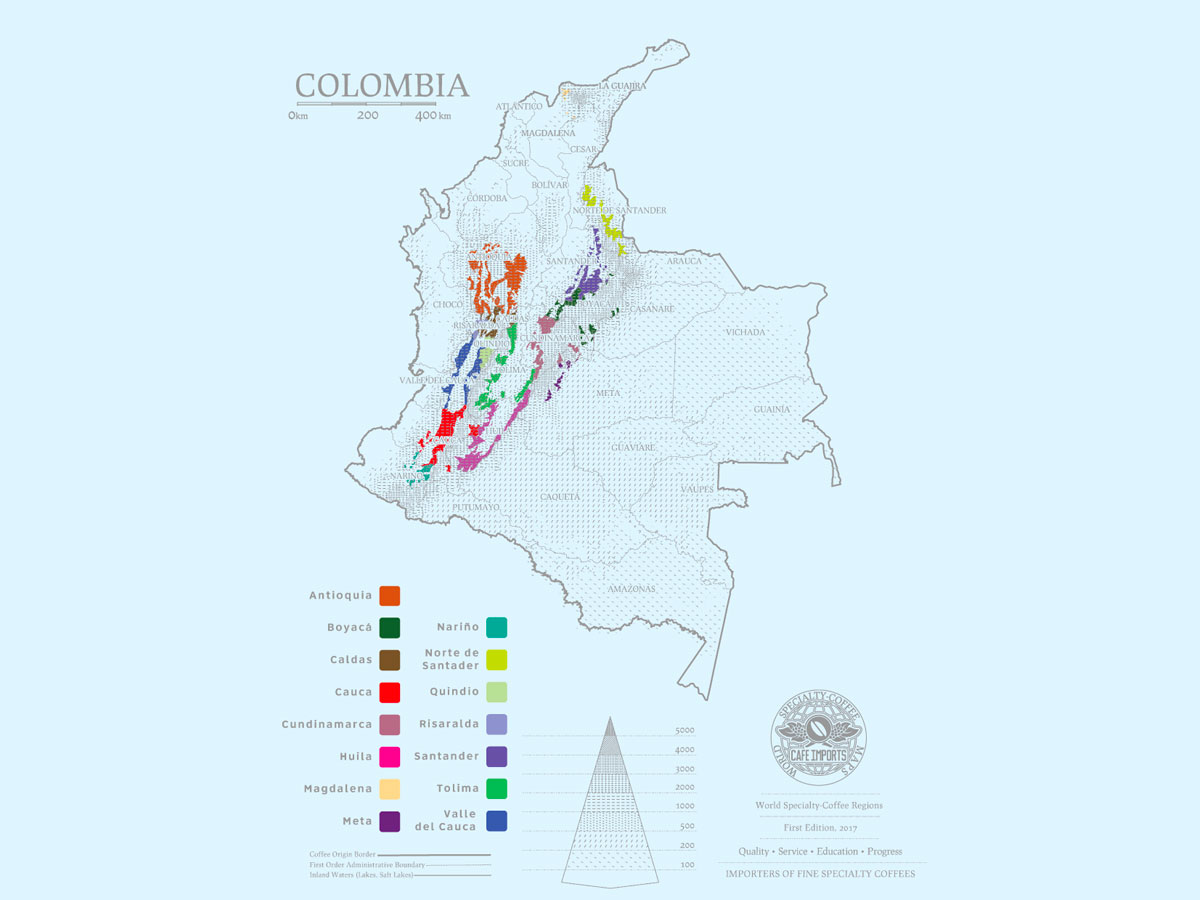
Colombia’s size alone certainly contributes to the different profiles that its 20 coffee-growing departments (out of a total 32) express in the cup, but even within growing regions there are plentiful variations due to the microclimates created by mountainous terrain, wind patterns, proximity to the Equator, and, of course, differences in varieties and processing techniques.
The country’s northern regions (e.g. Santa Marta and Santander) with their higher temperatures and lower altitudes, offer full-bodied coffees with less brightness and snap; the central “coffee belt” of Antioquia, Caldas, and Quindio among others, where the bulk of the country’s production lies, produce those easy-drinking “breakfast blend” types, with soft nuttiness and big sweetness but low acidity. The southwestern departments of Nariño, Cauca, and Huila tend to have higher altitude farms, which comes through in more complex acidity and heightened florality in the profiles.
To capitalize on this broad spectrum of flavors and to emphasize the diversity available to roasters and consumers from within a single country, the coffee growers’ association has begun to provide origin distinctions, and has developed aggressive marketing campaigns designed to boost the regions’ signals to buyers worldwide.